Skincare · Ingredient guide · 3 min read
How long do skincare ingredients take to work?
Hydration, uneven tone, and product testing run on different clocks. What five popular ingredients can—and cannot—tell you about results.
There is no single timetable for skincare. The useful first question is what you want to measure: how a moisturizer feels, an instrument’s hydration reading, or a visible change in pigmentation. Those are different outcomes.
This guide replaces fixed ingredient countdowns with the context behind the evidence. Research examines particular formulas, people, and schedules. A product containing the same named ingredient may not reproduce that study. Use the sources below to distinguish an observed study result from a promise about your own skin.
Vitamin C.
Results depend on the formula
Vitamin C appears in research on uneven pigmentation, but the evidence covers particular forms and delivery methods. A study of one preparation does not establish a two-to-four-week result for every serum. Look for evidence about the finished product, the outcome measured, and the length of follow-up. [1]
Bearberry and arbutin.
No universal brightening deadline
Arbutin is one of the ingredients evaluated in the hyperpigmentation review below. That is not the same as showing that every bearberry extract or botanical blend gives the same result. Check what the product actually contains before applying findings about arbutin to it. [1]
Kojic acid.
Study results are formulation-specific
Kojic acid has been studied for pigmentation concerns, including in combinations with other ingredients. Combination studies cannot tell you what kojic acid alone contributed. The review does not establish a universal three-to-six-week deadline for all products that list it. [1]
Hyaluronic acid.
Hydration and longer-term appearance differ
Hyaluronic acid is used as a moisturizing ingredient. In a 40-person study of one serum used with sunscreen, researchers measured increased hydration immediately after application and followed participants for six weeks. That finding challenges a blanket claim that hydration must wait two-to-six weeks; it does not promise identical results from every formula. Several authors were affiliated with the manufacturer. [2]
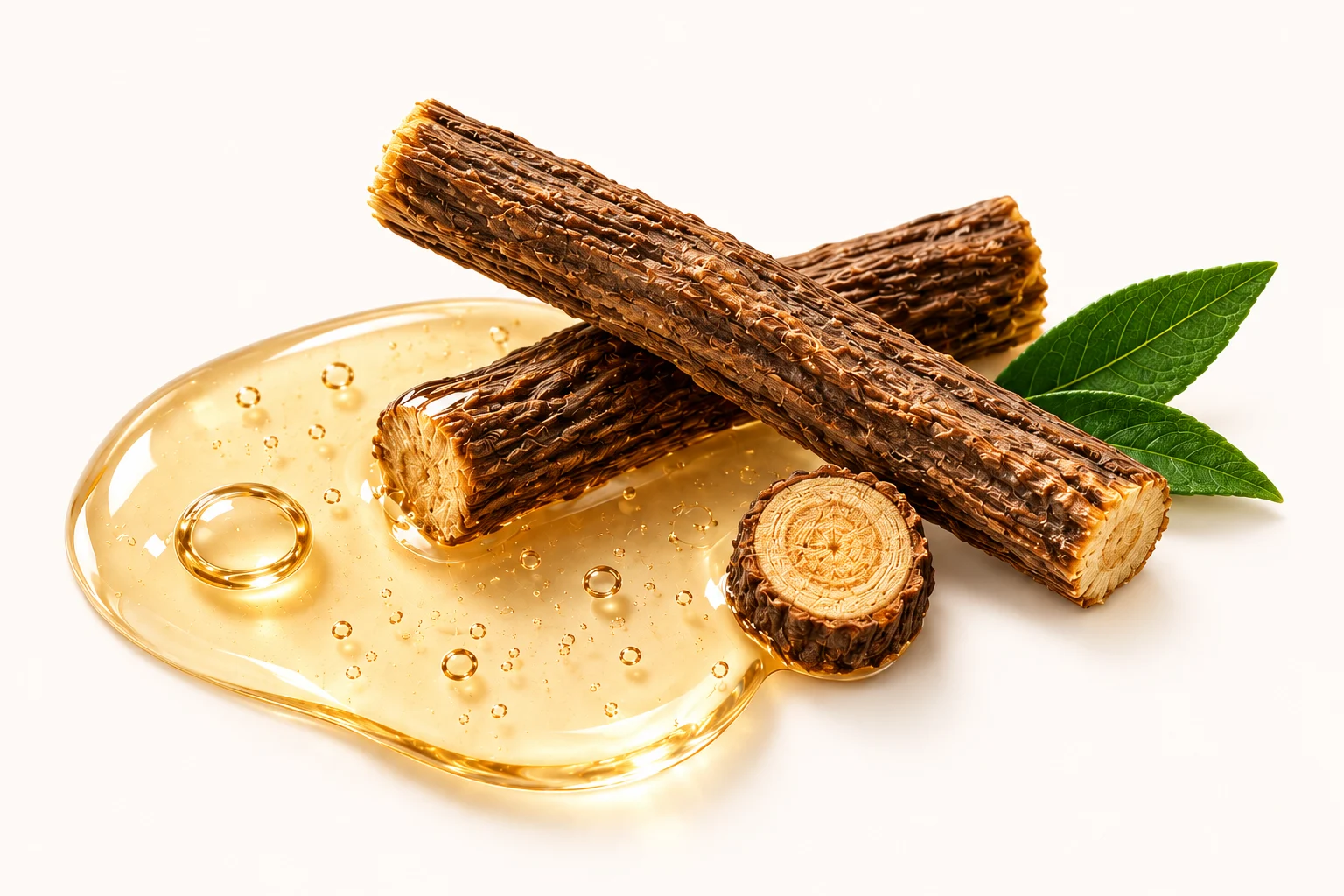
Licorice.
Evidence varies by extract and product
Licorice extracts also appear in clinical research on pigmentation. The review describes limited evidence across natural ingredients, rather than a reliable four-to-twelve-week promise for any licorice product. An ingredient’s laboratory properties and a visible result from a finished skincare product are different kinds of evidence. [1]
original sources.
- Are Natural Ingredients Effective in the Management of Hyperpigmentation? A Systematic Review (2018).
- Efficacy Evaluation of a Topical Hyaluronic Acid Serum in Facial Photoaging (2021).
These studies concern ingredients and topical products, not POÉ. This article is educational and does not prescribe treatment for a skin condition.
put it into practice.
Before you start, write down the change you hope to notice and the product’s own directions. An ingredient name alone cannot tell you how a finished formula will perform. Concentration, formulation, frequency, and your starting point all matter; study follow-up periods are context, not a deadline for your skin.
Keep the rest of your routine understandable while you assess a change. Note the start date, how often you actually use the product, and whether it feels comfortable. Use similar lighting for comparison photos and look at more than one snapshot. If you change several things together, be cautious about crediting one bottle for the result. Do not use a timeline as a reason to persist with a product that causes irritation.