Everyday rituals · 5 min read
How much skincare should you use?
How much skincare do you really need? A guide to the drops, dabs and directions that matter.
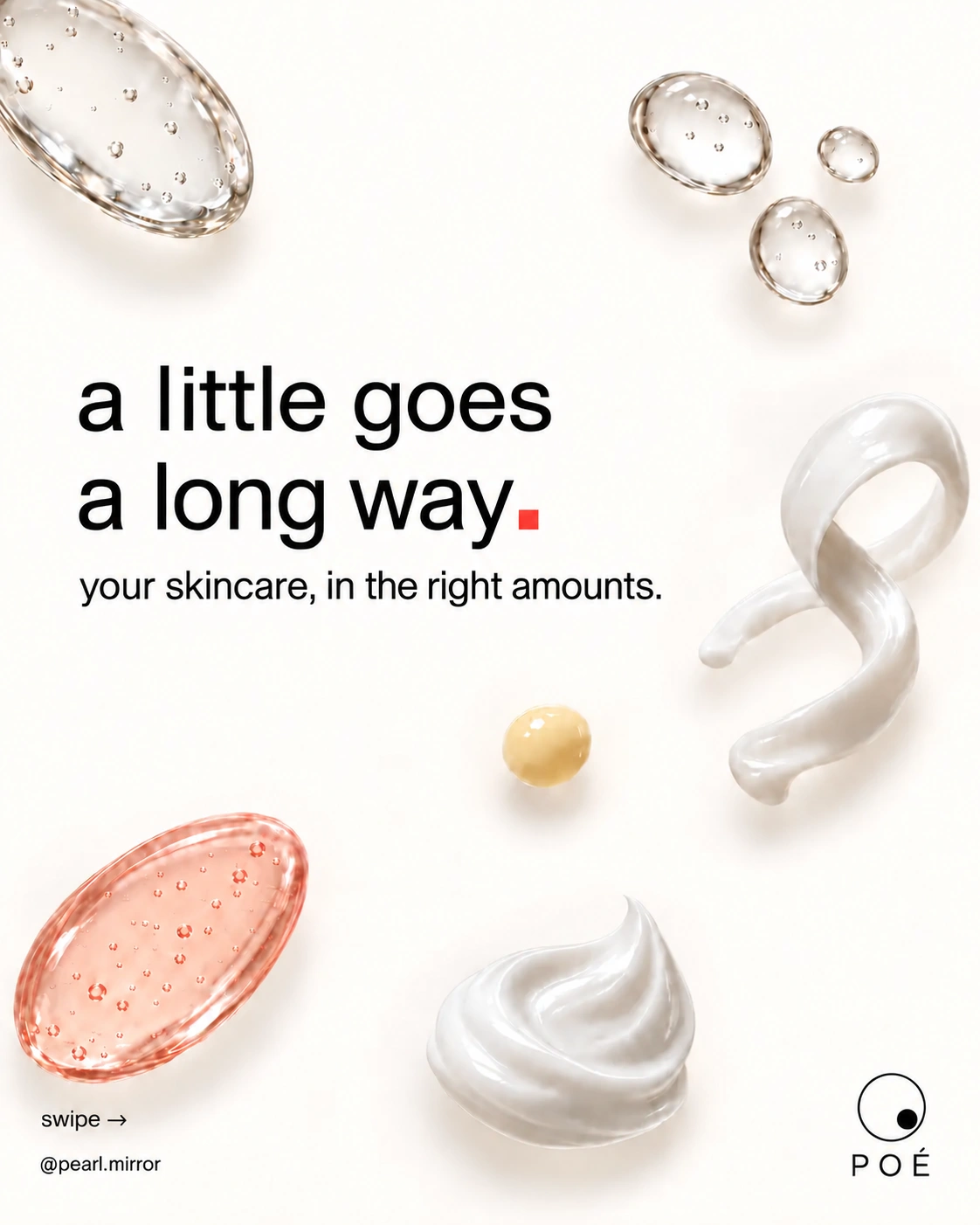
A few drops. A small dab. Another pump, just in case.
Skincare instructions can be surprisingly vague about the part you do every day: getting the product out of the bottle and onto your skin. What does “a small amount” actually look like?
Our floating textures turn that question into something you can picture. An almond of cleanser. A few drops of serum. A little cloud of moisturizer.
Think of them as visual cues, not universal measurements. The amount you need depends on the formula, the area you’re covering and the product’s instructions. Here’s how to use the guide without turning your bathroom into a measuring station.
Start with the label
A dropper, a pump and a squeeze from a tube won’t deliver the same amount. Even two serums can have very different textures and directions.
Use the quantities below to make sense of the visuals, then check your own product. If its instructions—or your prescriber’s—give a specific amount, follow those.
| Product | The visual cue | How to interpret it |
|---|---|---|
| Cleanser | An almond-sized amount | A starting point for some liquid or gel cleansers; concentrated formulas and balms may differ. |
| Toner | A coin-sized pool | A loose illustration, not a dose. Follow the directions for applying with hands, a pad or a mist. |
| Serum | Two or three drops | Useful only if it matches the formula’s instructions. Drops and pumps aren’t interchangeable. |
| Retinoid | A pea-sized amount | Check the specific product or prescription. Don’t assume every retinoid has the same directions. |
| Moisturizer | A small coin-sized dab | Adjust to the formula and the area you’re moisturizing. |
| Sunscreen | Finger-length strips | A visual reminder to apply generously, not a calibrated measurement. Follow the label and cover every exposed area. |
Cleanser: let the formula set the amount
An almond-sized squeeze is an easy shape to remember, but your cleanser may call for something different. A cleansing balm, foaming liquid and concentrated gel each have their own instructions.
Start there, including whether to apply to wet or dry skin and how to rinse it off. There’s no need to recreate the exact shape in the picture.
Toner and serum: count with context
The toner “coin” and serum “drops” make small quantities easier to imagine. They don’t tell you the strength of the product or how often to use it.
For serum, check whether the brand specifies drops, pumps or a thin layer. For toner, check the application method. A product designed to be misted won’t fit a coin-sized rule.
And this guide is a menu, not a six-step checklist. You don’t need to add a product simply because it appears here.
Retinoid: be precise about your product
This is where a catchy visual needs a little more context. “Retinoid” covers different products, strengths and instructions. A pea-sized cue shouldn’t replace the directions that came with yours.
Use the stated amount, on the stated area, at the stated frequency. If you’re unsure what your prescription means by a “thin layer,” ask your prescriber or pharmacist to show you.
Moisturizer: think about coverage
A small coin-sized dab gives you somewhere to start. It isn’t a target you have to hit.
Check the product directions and consider where it’s going. Covering your face and neck is different from applying to one small area. A rich cream also spreads differently from a lightweight lotion.
Sunscreen: give this step enough room
“A little goes a long way” isn’t an invitation to underapply sunscreen.
The American Academy of Dermatology recommends broad-spectrum, water-resistant sunscreen with SPF 30 or higher. Apply enough to cover exposed skin, including often-missed areas such as the ears and neck. Outdoors, reapply every two hours and immediately after swimming or sweating. Read the AAD’s application guidance.
Finger-length strips can be a handy visual cue, but fingers and tube openings vary. Treat the graphic as a reminder, and use your sunscreen’s instructions to guide the amount and application.
Make the routine yours
You don’t need identical dollops or a shelf full of steps. You need clear instructions for the products you actually use.
Save the visual guide. Check your labels. Leave a little less to guesswork.
Meet POÉ—a mirror that knows you.
put it into practice.
Make a quick reference from your actual product labels: how much to apply, where to apply it, and how often. Keep those directions ahead of a generic rule about peas, drops, or pumps. Different dispensers and formulas make those comparisons approximate, and a full-body sunscreen amount cannot simply be treated as a face-only dose.
The illustrations in this story help make quantities easier to imagine; they are not measuring devices. If the package gives an amount, use that instruction. If it is unclear, ask the manufacturer or a qualified professional rather than adding more until the product feels noticeable. Review application and reapplication separately for sunscreen, using the guidance linked in the article.