A closer look · 4 min read
Why your skin looks different in different lighting
Why your skin can look different from one room—and one photograph—to the next.
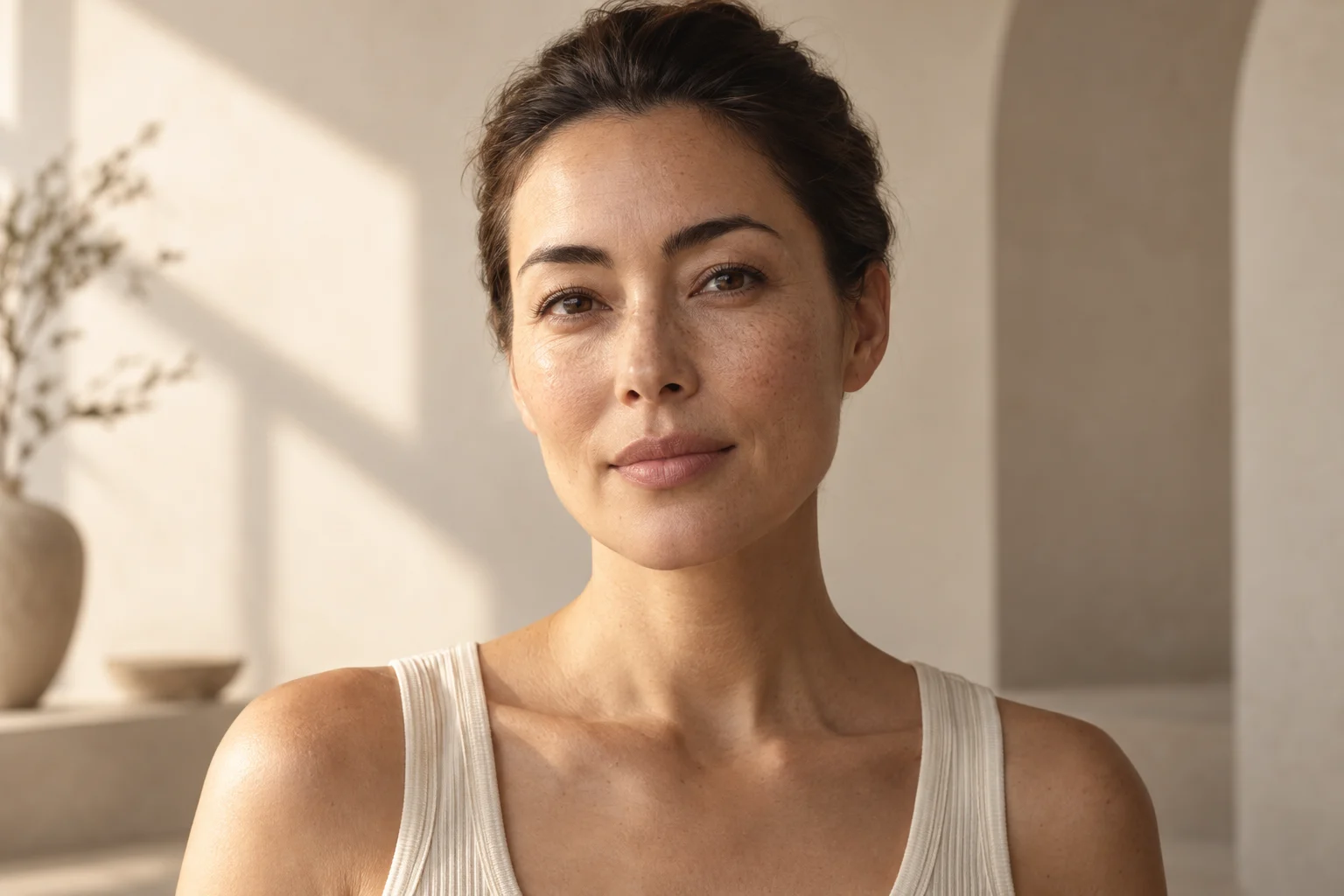
You catch your reflection before leaving home. Later, a bathroom mirror tells a different story. Then you open your phone camera. A third opinion.
It’s tempting to give each one a vote. Did I look tired all day? Was that makeup the wrong choice? Has my routine stopped working?
Before drawing a conclusion, there’s another question worth asking: what changed about the way you’re looking?
Light changes the emphasis.
Light arriving from different directions creates different patterns of highlight and shadow. Move the source, and different parts of the same face become prominent. More diffuse light produces gentler transitions; harder light creates sharper contrast. Photographers use those differences deliberately. [1]
Think of a portrait as a description with emphasis. The emphasis can move even when the subject stays still.
Color has a setting, too.
Light sources can give photographs a warmer or cooler cast. A camera’s white balance adjusts how those colors are rendered across the image. Mix different light sources, and different parts of a photograph can carry different casts. [2]
That matters when you compare a photo taken by a window with one taken under bathroom bulbs. A change in the image’s color is not, on its own, enough to establish a change in your skin. That is a limitation of the comparison, not a reason to dismiss something you’ve noticed.
Your camera’s distance joins the conversation.
Lighting is only one variable. Camera position can change apparent proportions, too.
In a 2018 research letter, researchers modeled how camera distance affects the apparent width of the nose relative to the face. At 12 inches, the model estimated roughly 29–30% greater apparent nasal breadth than an orthographic reference—a projection without perspective enlargement. At five feet, the difference was essentially absent. [3]
Those numbers describe a geometric model using average facial measurements. They are not a universal correction for every selfie, and the study did not measure skin quality. Its useful reminder is narrower: a close camera can change the proportions in an image without anything about the person changing.
A fairer comparison starts with the setup.
If you enjoy keeping a visual record, make the photographs easier to compare. Our photography checklist:
- Light: use a similar source and direction. The same room alone doesn’t guarantee the same light.
- Distance: keep the camera in a repeatable position rather than moving closer to inspect a detail.
- Presentation: use a similar angle and expression, and note whether you’re wearing makeup.
- Settings: keep filters and beauty effects off, and remember that automatic camera adjustments can still vary.
These are ways to reduce differences in the photographs. Even a carefully matched pair cannot, by itself, tell you why your skin changed or prove that a particular product caused it.
You’re allowed to leave it there.
You don’t have to turn every reflection into an assessment. Sometimes knowing that the setup matters is enough to put the phone down and get on with your day.
Enjoy your beauty ritual. Stay curious about what you see. And leave room for a picture to be just a picture.
You’re already beautiful.
Exactly as you are.
A little more reading.
- Adobe · How to use lighting for portrait photographyPhotographic guidance on light direction, diffusion, and contrast.
- Adobe · Adjusting white balance settings to improve photosHow illumination and white balance affect photographic color.
- Ward et al. · Nasal Distortion in Short-Distance Photographs: The Selfie Effect · 2018Original research letter in JAMA Facial Plastic Surgery. A perspective model, not a study of skincare outcomes.
put it into practice.
Choose one spot for comparison photos and return to it under similar lighting. Keep the camera at the same distance and angle, and avoid switching between a window-lit room and a ceiling spotlight. Turn off beauty filters and note whether you are wearing makeup. This makes the record easier to interpret, even though it does not turn a phone into a clinical instrument.
If two photos look unexpectedly different, check the setup before assuming your skin changed. Look at where shadows fall and whether the entire image looks warmer, cooler, brighter, or darker. Keep a note of comfort and texture as well as the image. The illustrations here explain the idea; they are AI-generated editorial images, not a controlled lighting experiment.